7 Things to Know Before EV Charger Installation in a Detached Garage
22Nov
by kmoser
0
Last Updated: November 22, 2026
Quick Summary
EV charger installation in a detached garage is feasible when your main panel has adequate capacity, the circuit is sized for the real one-way distance, and the charger location meets code clearances. The distance between house and garage usually decides whether the project stays simple or requires a service upgrade.
A 40-amp charger needs a 50-amp circuit because EV charging counts as a continuous load.
A 100-amp subpanel in the garage is common and leaves room for lighting, outlets, and a future charger.
For rigid PVC conduit, the common residential minimum is 18 inches of cover; direct-buried cable generally needs 24 inches.
Keep voltage drop on branch circuits under 3% and under 5% total from service to load.
Call 811 before excavation; Virginia law requires utility locates, and marking services are free.
Detached garage charger feeling out of reach?Moser Electric handles load calculations, panel upgrades, and trenching for detached garage EV chargers in Moneta, VA.
Can a Detached Garage Support a Level 2 EV Charger?
Yes, a detached garage can support Level 2 EV charger installation in a detached garage in most cases, but only when three conditions line up: adequate electrical capacity at the main panel, a properly sized circuit run to the garage, and a charger location that meets code clearances. The distance between house and garage is usually what decides whether the project stays simple or turns into a service upgrade.
A garage 20 feet from the panel is straightforward; one 120 feet away across a driveway is a design problem first.
Below are the seven factors that determine feasibility, cost, and timeline, in the order a qualified electrician evaluates them.
Assessing Your Existing Electrical Supply and Panel Capacity
Start with the panel, not the charger. A Level 2 charger draws continuous current for hours, and the National Electrical Code treats EV charging as a continuous load, meaning the circuit must be sized at 125% of the charger’s rated draw.
Open the panel and answer three questions:
What is the main service rating, 100-amp or 200-amp?
How many open breaker spaces remain?
What does the panel’s labeling say about existing large loads?
A load calculation is the formal math that compares your home’s total demand against the service rating. It follows Article 220 of the National Electrical Code (NFPA 70), adding general lighting, small appliance circuits, fixed appliances, and your largest motor loads, then applying demand factors.
Available capacity is what’s left after that total. If there’s headroom for the charger’s continuous load, you’re clear. If not, reduce the charger’s amperage or upgrade the service.
Electrical Panel Upgrade Requirements for Garage EV Charging
A panel upgrade becomes necessary when the load calculation fails, when the panel is a known problematic model, or when there simply aren’t two open spaces for a double-pole breaker. Some older panel models are often replaced rather than reused.
Upgrade requirements typically include:
A new service panel rated for the calculated load, usually 200-amp
A new service mast, meter base, and grounding electrode system where required
Permit and inspection by the local authority having jurisdiction
Watch out: skipping the load calculation and installing a charger on a panel that can’t carry it is the most common mistake we correct. The breaker trips under real load, or worse, the panel runs hot for years unnoticed.
If your evaluation points to an upgrade, our panel upgrade service covers the full scope from load calculation through final inspection.
Running a New Circuit: Subpanel, Feeder, and Wire Sizing
The distance question has a technical answer: voltage drop. Code guidance in NEC Article 210.19(A) informational notes recommends keeping voltage drop on branch circuits under 3% and under 5% total from service to load.
Wire sizing for a detached garage feeder depends on four inputs:
Factor
What It Determines
Typical Consideration
Charger amperage
Breaker size
40A charger → 50A circuit
One-way distance
Conductor size
Longer runs need larger wire
Conductor material
Ampacity
Copper vs. aluminum
Installation method
Derating
Conduit fill, burial depth, temperature
A 100-amp subpanel in the garage is common because it leaves room for lighting, outlets, and a future second charger, and means one trench, one feeder, and one permit.
Existing Circuit vs. New Dedicated Circuit
An EV charger requires a dedicated circuit. Sharing an existing garage circuit, even a 240-volt dryer or welder circuit, creates a code violation and a real overload risk, because the charger runs continuously while other loads cycle on.
The only defensible reuse scenario is a circuit installed for EV charging that’s already correctly sized, protected, and labeled. For more than one vehicle, our guide to home EV charger installation for two cars covers load sharing and panel sizing.
Trenching Costs for Electrical Conduit and Underground Wiring
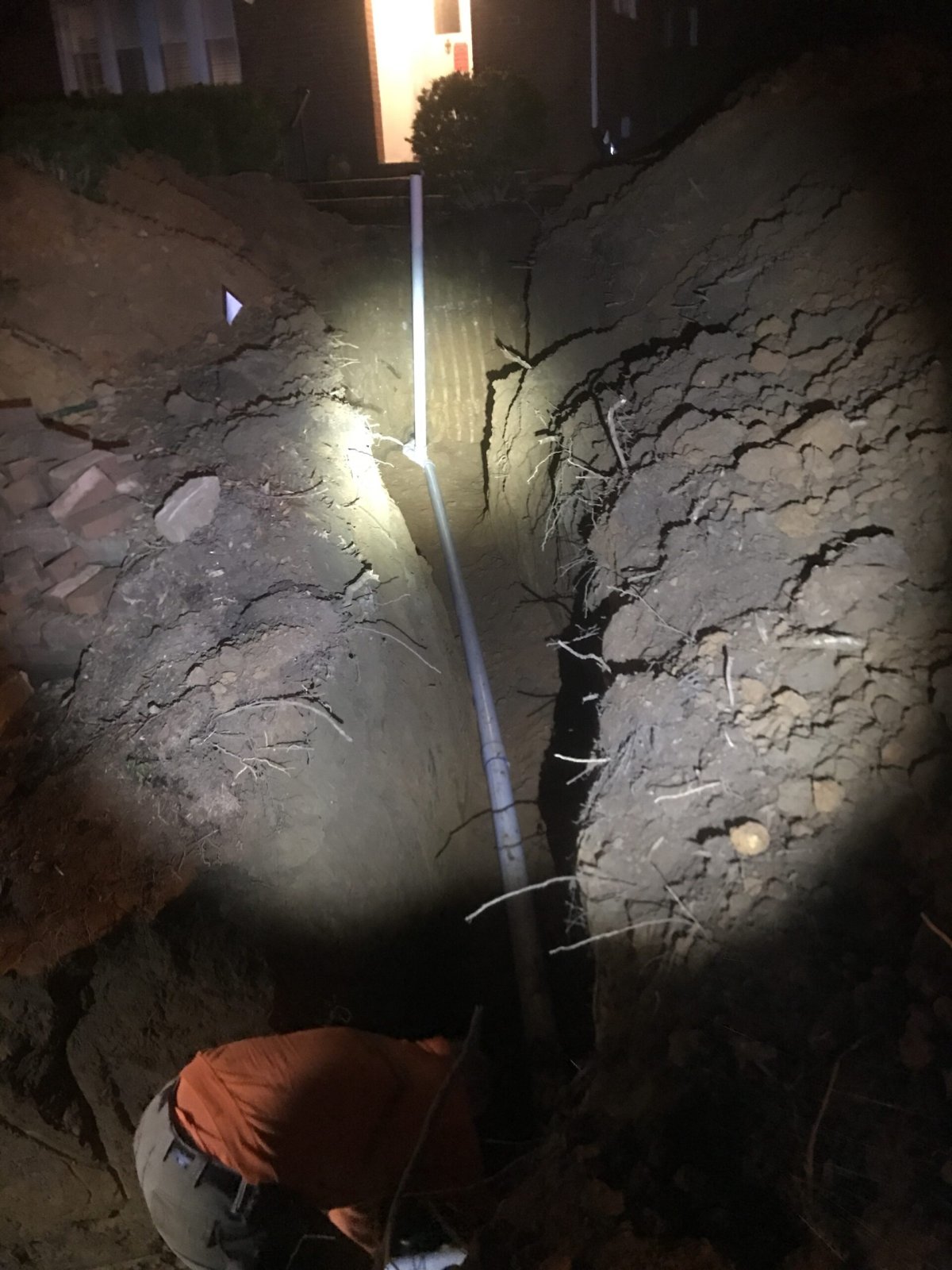
Trenching is often the largest single line item on a detached garage project and the one homeowners most often underestimate. Cost is driven by one-way run length, soil and surface conditions, required burial depth, and conduit and conductor sizing.
Nighttime photo of a trench dug in soil with a white pipe being laid, lit by a flashlight, with a worker in an orange shirt kneeling at the bottom.
What Drives the Trenching Line Item
Excavation and backfill: priced per linear foot and heavily dependent on soil. Hand-digging through rocky Virginia clay costs far more per foot than machine trenching through loam, and a path that crosses a concrete driveway or paver patio adds cutting and restoration.
Burial depth: the National Electrical Code sets minimum cover for underground feeder and branch-circuit conductors in NEC Article 300.5. For rigid PVC conduit, the common residential minimum is 18 inches of cover; direct-buried cable generally requires 24 inches. Deeper trenches cost more to dig and backfill.
Conduit: PVC Schedule 40 is typical underground, with Schedule 80 required where the conduit is exposed to physical damage, such as the riser up the garage wall. Sweep elbows, expansion fittings, and pull points add material and labor.
Conduit Sizing and the Cost of Undersizing
Conduit size is set by the number and size of conductors inside it, following the fill rules in NEC Chapter 9, Table 1.
A common mistake is burying undersized conduit to save money. Pulling larger conductors later through a 3/4-inch conduit that’s already full isn’t possible, and re-trenching costs far more than the conduit upgrade would have. If a second EV or a future shop is plausible, run spare capacity now.
Distance Math: Why 100 Feet Is Not 20 Feet
A 20-foot run from the panel to a garage on the same wall is a short branch circuit. A 120-foot run across a driveway is a feeder design problem.
Call 811 before anyone puts a shovel in the ground. Virginia law requires utility locates before excavation, and marking services are free. Hitting a private line that wasn’t marked is on the homeowner.
EV Charger Installation Permit Moneta VA: What to Expect
An EV charger installation permit Moneta VA follows the same basic sequence as any residential electrical permit: application, plan review, rough-in inspection, and final inspection.
Here’s what the sequence looks like in practice:
Permit application. Submit the charger model, circuit size, panel details, and a site sketch showing the charger location and conduit route.
Plan review. The county confirms the load calculation and wiring method meet the adopted code edition.
Rough-in inspection. Conductors, conduit, and box installation are inspected before drywall or backfill closes them in.
Final inspection. The completed installation, including GFCI protection and labeling, is inspected and approved.
Utility coordination. If a service upgrade is part of the scope, the utility schedules a disconnect and reconnect.
Watch out: installing the charger before pulling the permit is the costliest mistake to fix.
Charger Amperage, Charging Speed, and Long-Run Voltage Drop
Charging speed scales with amperage, capped in sequence by the circuit you install, the charger’s maximum output, and your vehicle’s onboard charger. The weakest link sets the ceiling, so a 48-amp charger does nothing if the car accepts only 32 amps or the panel can’t carry a 60-amp circuit.
Matching Circuit, Charger, and Vehicle
Because the National Electrical Code treats EV charging as a continuous load, the circuit must be sized at 125% of the charger’s rated draw. That produces the standard pairings:
A 40-amp charger needs a 50-amp circuit and adds roughly 30 to 35 miles of range per hour for a typical efficient EV.
A 48-amp charger needs a 60-amp circuit and adds somewhat more, but only if the vehicle’s onboard charger accepts 48 amps.
A 32-amp charger on a 40-amp circuit is a common compromise when panel capacity is tight; it charges slower but keeps the service within its calculated load.
Most Level 2 home charging happens overnight, when the vehicle sits for eight hours or more. A 32-amp setup that fully recharges overnight is often a better value than a 48-amp setup that forces a service upgrade.
How Voltage Drop Actually Affects a Long Garage Run
Voltage drop is the long-run tax, and it is a design input, not an afterthought. Code guidance in NEC Article 210.19(A) informational notes recommends keeping voltage drop on branch circuits under 3% and under 5% total from service to load.
What happens physically: undersized conductors lose voltage and generate heat, and the charger compensates by drawing slightly more current to deliver the same power. Over years of continuous charging, that heat ages terminations and insulation.
A Practical Sizing Method
The sequence a qualified electrician follows on a long detached-garage run:
Confirm the charger’s rated draw and the resulting circuit size (125% rule).
Measure the true one-way distance, including the vertical risers at both ends, not just the trench length.
Select conductor material and size for ampacity at the actual conditions, then check voltage drop at the calculated load.
If voltage drop exceeds the recommended threshold, increase conductor size before increasing conduit size, then confirm the conduit still meets fill rules.
Verify terminations, antioxidant compound on aluminum, and torque to the manufacturer’s specification.
Three practical rules we follow:
Never size wire to the minimum ampacity alone on a long-distance run.
Use aluminum feeder where the ampacity math favors it, with proper antioxidant terminations.
Leave spare conduit capacity for a future second charger.
Watch out: a quote that specifies conductor size without stating the one-way distance it was calculated for is a quote you cannot compare to another bid. Ask for the distance and the voltage-drop check in writing.
Getting a Quote from Moser Electric for Your Detached Garage
A useful quote answers five things: what the load calculation shows, whether the panel can carry the charger, the wire and conduit sizes specified, the permit and inspection scope, and what isn’t included. Get those in writing before comparing numbers.
Compare quotes on this checklist:
Load calculation included and documented
Panel capacity stated with available amperage
Conductor size and material specified for the actual run distance
Detached garage charging rewards planning more than speed. Get the load calculation right, size the run for the real distance, and pull the permit before the first shovel moves, and the project stays predictable.
Frequently Asked Questions
Is it safe to install a Level 2 EV charger in a detached garage?
Yes, when the circuit is sized correctly and installed by a qualified electrician. A detached garage EV charger needs a dedicated circuit, proper grounding, and a panel that can carry the added load. A load calculation confirms available capacity before work starts. In Moneta and across Virginia, the installation must meet the current electrical code and pass inspection. Skipping those steps is where safety problems start.
How does distance from the main panel affect EV charger installation costs?
Distance drives cost because it sets wire size, conduit length, and trenching. A short run along a shared wall is simple. A long-distance run of 100 feet or more may need larger conductors to limit voltage drop, plus conduit and trenching. Each added foot of trench and heavier wire raises material and labor. An on-site quote accounts for the actual cable run, not a guess.
What electrical upgrades are required for a detached garage EV charger?
Many homes need a panel upgrade, a subpanel in the garage, or both. If the main panel lacks available capacity, a service upgrade may be required. A 50-amp circuit is common for Level 2 charging, though some setups use a smaller circuit with load management. An electrician performs a load calculation and checks the existing supply before recommending the least costly compliant option.
Do I need a trenching permit for electrical work in Moneta, VA?
Trenching and underground wiring usually fall under the electrical permit, and some localities require a separate right-of-way or excavation permit. Requirements vary by county and by whether the trench crosses public property. Confirm with the local building department before digging, and call 811 to mark utilities. A licensed contractor handles the permit paperwork and inspection scheduling for you.
We use cookies to ensure that we give you the best experience on our website. If you continue to use this site we will assume that you are happy with it.