Home EV Charger Installation for Two Cars: What to Know
15Nov
by kmoser
0
Last Updated: November 15, 2026
Quick Summary
Home EV charger installation for two cars comes down to choosing one dual-port charging station or two separate wall-mounted units. A dual-port station shares a single power feed and splits output between both vehicles, while two separate units give each car its own dedicated circuit and full charging speed but draw more from your electrical panel.
A single Level 2 charger typically needs a 40- to 60-amp dedicated circuit.
Load management systems throttle charging when home demand spikes, allowing two cars to charge without a service upgrade.
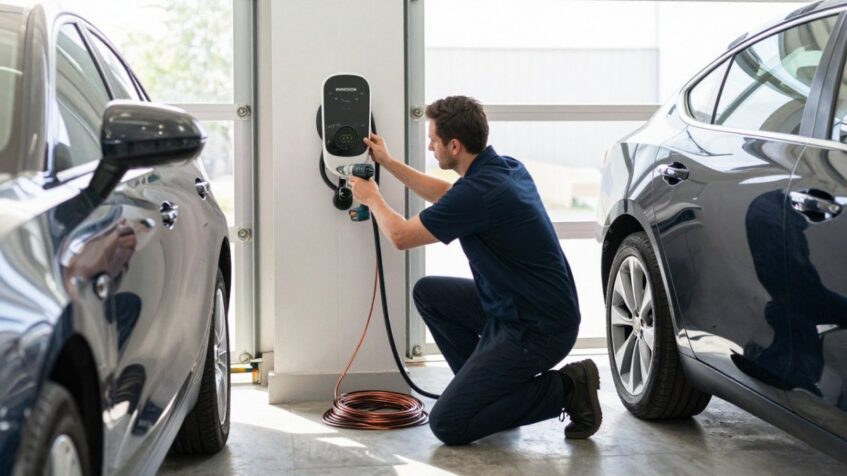
Two wall-mounted units on opposite sides of a two-car garage keep each cable at its own parking spot.
A building permit and inspection add a fixed cost per project and are required for a legitimate installation.
Moser Electric has over 21 years of experience with residential and commercial electrical work.
Two EVs, one panel: can your home handle it?Moser Electric handles load calculations, panel upgrades, and two-car charger installation across the region.
Dual-Port Charging Stations vs. Two Separate Units
Home EV charger installation for two cars comes down to one early decision: one dual-port charging station or two separate wall-mounted units. A dual-port station shares a single power feed and splits output between both vehicles. Two separate units give each car its own dedicated circuit and full charging speed, but they draw more from your electrical panel. Homeowners in Moneta and the surrounding region can review this trade-off with a qualified electrician before any equipment is ordered.
How Simultaneous and Sequential Charging Differ
Simultaneous charging splits available power across both ports at once. Sequential charging, common in power-sharing systems, gives one vehicle full output and switches to the second when the first finishes. A dual-port unit with power sharing handles two overnight sessions without tripping a breaker, while two independent Level 2 chargers can run at full amperage together only if your service and panel support the combined load. For most two-car households, the practical question is not which charger is faster. It is how much capacity your home can actually deliver.
Setup
Power Feed
Best For
Main Trade-off
Dual-port station (power sharing)
One dedicated circuit
Tight panels, one-wall garages
Slower when both charge at once
Two separate Level 2 units
Two dedicated circuits
Two high-mileage EVs
Higher panel and labor demand
Dual-port, sequential
One circuit
Overnight top-ups
One car waits its turn
Electrical Panel Upgrade for EV Charging: When Two Cars Force the Issue
An electrical panel upgrade for EV charging becomes necessary when the combined load of two chargers pushes your service past its rated capacity. A single Level 2 charger typically needs a 40- to 60-amp dedicated circuit. Two of them can demand more than an older 100-amp service can spare alongside a home’s existing appliances. That is the point where a panel upgrade, a load management system, or a shared dual-port setup decides the project.
Load Calculations for Older Homes
Older homes often carry panels and wiring installed decades ago. A proper electrical load calculation accounts for existing square footage, major appliances, heating and cooling, and the new EVSE load before a design is chosen. The calculation, not the charger spec sheet, is what determines whether a service upgrade is needed.
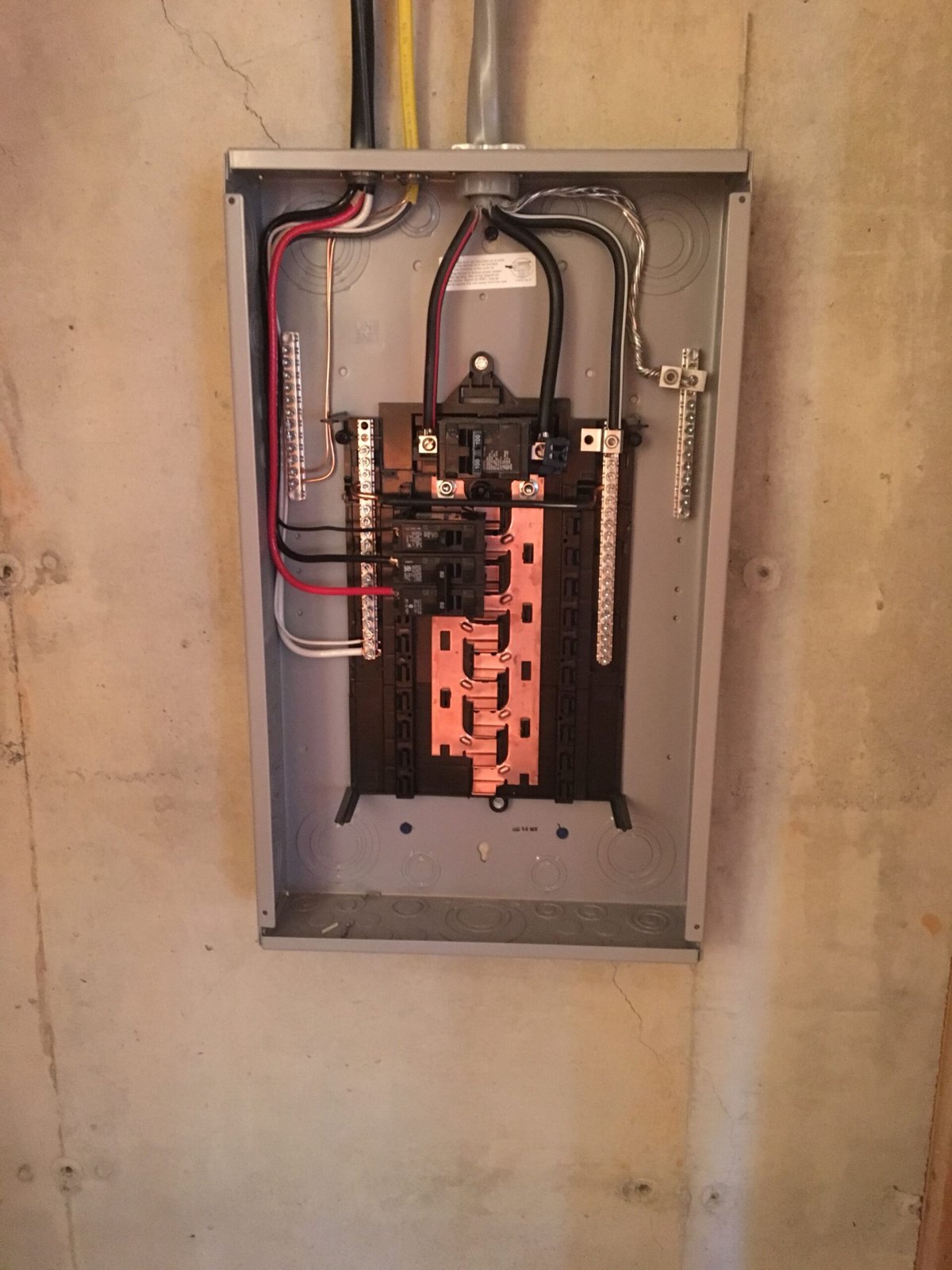
A residential electrical panel with its cover removed, showing circuit breakers, copper busbars, and neatly routed wires inside a gray metal enclosure mounted on a concrete wall.
EV Charger Load Management Systems That Share Power Safely
EV charger load management systems monitor a home’s total electrical draw and throttle charging when demand spikes, so two cars can charge without a service upgrade. The mechanism matters more than the marketing: current transformers clamp around the service conductors at the panel, a controller reads whole-home demand continuously, and it signals the EVSE to reduce amperage in real time. When the dryer, range, or heat pump cycles on, charger output drops; when the house quiets down, charging ramps back up. The result is safe simultaneous charging on a service that could not otherwise support two Level 2 units at full amperage.
Load management can be a practical option on older homes with limited panel capacity, where a service upgrade would otherwise be needed. Whether it is cheaper than an upgrade depends on the specific home and its load calculation.
Panel-level monitoring: current transformers track whole-home demand and cap charger output dynamically, so the service never exceeds its rating
Power sharing between ports: a dual-port station splits a single circuit between two vehicles, which is the simplest path when only one breaker space is available
Smart scheduling: chargers default to off-peak hours to reduce strain and take advantage of lower utility rates
Hardwired connection: most load management setups are hardwired for reliability, and hardwiring is generally required for the controller itself
Load management does not make charging faster. It can make two-car charging possible on a panel that would otherwise need replacement. If your load calculation shows headroom, two independent circuits remain the simpler long-term design.
Load management hardware should be listed and installed per the manufacturer’s instructions and the adopted electrical code, and the controller must be wired to the service it is monitoring.
Home EV Charger Installation Cost: Equipment, Labor and Panel Work
Home EV charger installation cost for two cars generally breaks into four line items: equipment, circuit labor, panel or service work, and permitting. Here is how each line item typically behaves on a two-car project.
Equipment. A basic wall-mounted Level 2 unit is the lowest-cost option. A dual-port station with power sharing costs more up front but can eliminate a second circuit run. Two separate Level 2 units cost the most in equipment but give each car full amperage.
Circuit labor. Labor covers conduit, conductor, the breaker, and either a NEMA 14-50 outlet or a hardwired connection. The two variables that move this number most are run distance from the panel to the parking spot and whether the run is surface-mounted conduit in a garage or fished through finished walls. A short surface run in an attached garage is the low end; a long buried run to a detached carport is the high end. Hardwired installs avoid the cost of a 14-50 receptacle but add a disconnect in some configurations.
Panel and service work. When it is needed, this can be a significant line item. A panel upgrade or a new service can exceed the combined equipment and labor cost of the chargers themselves. Load management is an alternative to a service upgrade: a controller and current sensors throttle charging to stay within existing capacity.
Permitting. A building permit and inspection add a fixed cost per project and are required for a legitimate installation. Skipping the permit saves money up front and creates a problem at resale or insurance claim time.
Because every home’s load calculation differs, pricing depends on panel condition, run distance, and equipment selection. For current pricing or a quote, contact Moser Electric directly through its website. Homeowners who want to understand the panel side of the quote first can explore panel upgrade services or read more about how an electrical panel upgrade protects your home.
Watch out: a quote that lists only charger equipment and labor, with no load calculation and no panel line item, can leave a two-car project under-scoped.
Garage, Carport and Conduit Planning for Two Charging Spots
Garage and carport layouts affect where chargers mount and how cable management works day to day. Two wall-mounted units on opposite sides of a two-car garage keep each cable at its own parking spot. A single dual-port station on the shared wall works when cars park side by side. Conduit installation along the wall or through the attic keeps wiring protected and neat, and a hardwired setup avoids exposed outlets at bumper height. Voltage drop over long runs from the panel to a detached carport is a real planning factor, so we size conductors for the distance, not just the amperage.
The man is American.
Permits, Code and Virginia Utility Rebates for Two-Car Charging
Building permits and local code compliance are part of every legitimate EV charging station installation. A dedicated circuit for each charger, proper grounding, and ground fault circuit interrupter protection are standard requirements, and an inspector signs off before the circuit is energized. Utility rebate programs for home charging change periodically, so homeowners should check their utility’s current program page for details. For climate-specific planning, weather-rated equipment and secure conduit are worth considering for any exterior carport run.
Scheduling Your Two-Car Charger Installation with Moser Electric
Moser Electric has over 21 years of experience with residential and commercial electrical work, and offers full-service electrical solutions. For current pricing or to schedule an assessment, contact Moser Electric through its website. Homeowners searching for an electrician near me in the Moneta area can reach our Lynchburg service team or connect with our Bedford electrician team to book an assessment. Before you commit, you can also read client reviews to see how we work in people’s homes.
Two cars and one panel is a solvable problem, but only when someone runs the numbers first. Moser Electric brings more than two decades of full-service electrical experience to every charger project, from load calculations and panel upgrades to hardwired installations and generator work, with recommendations tailored to your home and a respectful presence throughout. Get started with Moser Electric and charge both vehicles safely on a system built to code.
Frequently Asked Questions
Can a single home EV charger charge two cars?
A single-port charger charges one car at a time, so two cars means either taking turns or adding a second unit. A dual-port charging station solves this by splitting power between two cables, though most models share the available amperage rather than delivering full speed to both at once. If both drivers need a full charge overnight, two dedicated circuits or a load management system is usually the better fit.
Do I need a panel upgrade to install two EV chargers?
Not always. An electrician runs a load calculation on your existing service first. If the panel has spare capacity, two 240-volt circuits can often be added without upgrading. Older homes with 100-amp service frequently do need an electrical panel upgrade for EV charging, especially when other large loads like electric heat or a hot tub are present. A load management system can sometimes avoid the upgrade by pausing charging when demand peaks.
What does home EV charger installation cost include?
Home EV charger installation cost depends on the charger itself, the length and route of the circuit, whether the unit is hardwired or uses a NEMA 14-50 outlet, and any panel work required. A straightforward install near the panel costs far less than a long conduit run across a garage or a service upgrade. For current pricing or a quote, contact Moser Electric through its website.
Can Moser Electric handle permits for an EV charger installation in Moneta?
Permits and inspections are required for a legitimate EV charger installation. Confirm with your local building department what is required for your project.
We use cookies to ensure that we give you the best experience on our website. If you continue to use this site we will assume that you are happy with it.