Electrical Panel Upgrade: When Your Home Needs More Power
An electrical panel upgrade replaces or increases the capacity of your home’s main breaker panel so it can safely handle your current and future electrical demand.
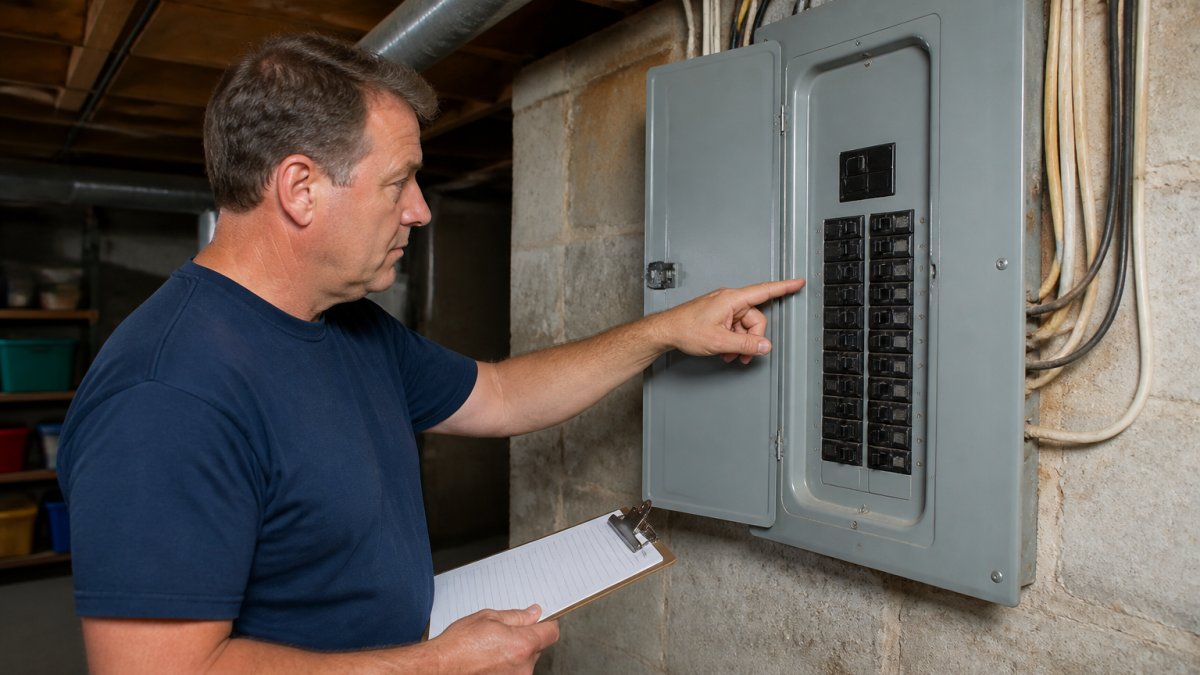
Homeowner with a clipboard examining a tripped breaker during an electrical panel upgrade in their basement
A panel that trips, hums, or runs warm is telling you something. Common signs:
Breakers that trip repeatedly, even with normal appliance use
Lights that flicker or dim when a large appliance kicks on
A panel that feels warm or smells faintly of burning
If two or more of these apply, schedule an inspection before adding any new load.
Frequent Circuit Breaker Tripping and Flickering Lights
Frequent breaker tripping is the most common reason homeowners call us. It usually means an overloaded circuit, a failing breaker, or a panel that can’t distribute the load your home now demands. Flickering lights point to the same issue: when your refrigerator, HVAC system, and microwave pull power at once, a panel at its limit will let you know.
Watch Out Don’t keep resetting a breaker that trips repeatedly. A breaker that trips is doing its job. If you override it with a larger breaker or ignore it, the wiring behind the wall can overheat, and that’s where house fires start.
Electrical Panel Replacement vs. Upgrade: What’s the Difference?
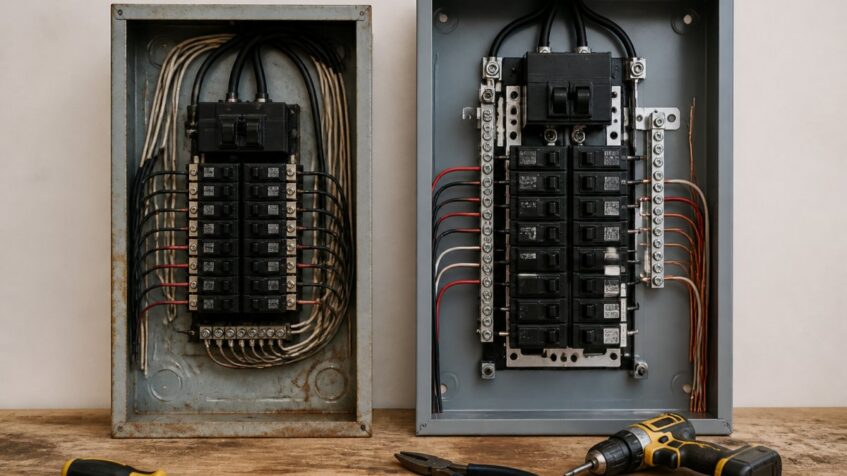
These terms get used interchangeably, but they mean different things. Electrical panel replacement swaps an old or failed panel for a new one of the same capacity. An electrical panel upgrade increases capacity, usually from 100-amp to 200-amp service, to support modern demand.
The right call depends on your wiring, planned loads, and what your utility and local code require.
Outdated or Unsafe Panels That Require Replacement
Some panels are replaced for safety regardless of capacity. Certain older types have a documented history of failure, and federal agencies have issued recalls or warnings on specific models. If your panel falls into a known hazardous category, replacement isn’t optional, a licensed electrician can identify it in minutes.
When a Subpanel Solves the Problem Instead
A subpanel is a secondary breaker box fed from your main panel. It’s the right answer when your main service has enough capacity but you need more space for circuits, or you’re running power to a detached garage, workshop, or addition. It costs far less than a full service upgrade and takes a fraction of the time, but it can’t increase your home’s total available power, if your main service is maxed out, a subpanel just moves the bottleneck.
Electrical Panel Upgrade Cost: What Changes Your Quote
Electrical panel upgrade cost varies widely based on your home, your utility, and your local jurisdiction. We don’t quote flat prices because no two panels are the same, and we’d rather give an honest number after an inspection than a lowball figure that grows later. A panel upgrade quote is five separate jobs bundled together, and each moves independently.
The Five Line Items in Every Panel Upgrade Quote
1. The panel and breakers (equipment). A 200-amp main breaker panel with a full set of branch breakers is the core equipment cost.
2. Labor (the swap itself). Labor scales with complexity, not amperage.
3. Service entrance work. This is the part homeowners underestimate.
**4.
5. Utility disconnect and reconnection. Your utility must pull the meter and later re-energize the service.
What Actually Moves the Number
Amperage change: 100-amp to 200-amp is a bigger job than a same-size replacement because it usually triggers service entrance upgrades.
Service entrance condition: aging meter bases, corroded mast, or undersized wiring.
Utility disconnect and reconnection: some utilities charge, some don’t.
Regional Variation Is Real
Two identical homes in two different states can get quotes that differ by thousands of dollars for the same scope. The drivers are local labor rates, permit fees, utility rules, and how aggressively your state has adopted recent editions of the National Electrical Code. A jurisdiction on an older code cycle may allow work a newer-code jurisdiction requires you to upgrade.
Pro Tip Ask any contractor for an itemized quote that separates labor, materials, permits, and utility fees. A single lump-sum number hides the parts that change most often. If a quote doesn’t break it down, ask why.
How to Compare Two Panel Upgrade Quotes
With two or three quotes in hand, don’t compare the bottom line. Compare these six things:
Service size: Is each quote proposing the same amperage, or is one quoting a same-size replacement while the other quotes a true upgrade?
Service entrance scope: Does the quote include meter base, mast, and conductor replacement if needed, or is that a change order waiting to happen?
Permit handling: Who pulls the permit, and is the fee included or billed separately?
A quote that’s lower because it excludes the service entrance, permit, or utility fee isn’t actually lower, it’s incomplete. Compare scope-to-scope, not price-to-price.
100 Amp to 200 Amp Panel Upgrade: Is It Worth It?
For most modern households, yes. A 100 amp to 200 amp panel upgrade is the standard move when a home adds an EV charger, heat pump, tankless water heater, or large kitchen remodel. It roughly doubles your available service capacity and leaves room for future loads without another upgrade later. The exception is a small home with gas appliances and no planned additions, where a same-size replacement may be all you need.
Calculating Current and Planned Household Electrical Loads
An electrician calculates your load by adding the wattage of every major appliance, then applying a demand factor for what runs simultaneously. Current loads matter; planned loads matter more. If you’re buying an EV in the next two years, tell your electrician now, running the service upgrade once is far cheaper than doing it twice.
How Long Does an Electrical Panel Upgrade Take?
A straightforward electrical panel upgrade typically takes one day of on-site work, with power off for several hours during the swap. The full project timeline, from first call to final inspection, is longer:
Inspection and quote: 1 to 3 days
Permit filing and approval: varies by jurisdiction, often 1 to 2 weeks
Utility coordination: scheduling the disconnect and reconnect
Plan for a week or two of calendar time even when the work itself is a single day. Add time if your home needs a service entrance rebuild or mast replacement.
Key Takeaway The panel swap is fast. The permits, utility scheduling, and inspection are what stretch the timeline. Ask your electrician to walk you through each step before you commit.
Permits, Code Compliance, and Choosing a Licensed Electrician
Every electrical panel upgrade requires a permit in nearly every U.S. jurisdiction, and the work must meet the National Electrical Code as adopted by your state and locality. Skipping the permit risks your insurance coverage and creates problems when you sell. The permit is what connects your job to the inspection that proves it was done correctly.
How the Permit and Inspection Process Actually Works
A panel upgrade permit is not a formality. It sets off a sequence most homeowners have never been through:
Application and plan review. The electrician files the permit with your local building department, describing the scope: service size, panel location, and added circuits. Some jurisdictions review the same day; others take longer, especially with a service entrance change.
Permit issuance. Once approved, the permit is posted at the job site. The permit number is what the inspector references.
Utility coordination. The utility must disconnect the service before the swap. Many jurisdictions require the permit issued first, so you can’t skip it and catch up later.
Rough inspection (when applicable). If the job includes new circuits or service entrance work, an inspector may want to see the rough wiring before the panel is closed up. A straight swap often skips this.
Final inspection. After the panel is installed and energized, the inspector verifies the work against the adopted code and produces the sign-off.
Utility reconnection and sign-off. The utility re-energizes the service and the jurisdiction closes the permit, your documentation that the work was inspected and approved.
Code Adoption Varies by Jurisdiction, and It Matters
The National Electrical Code is a model code with no force of law on its own.
The consequence: the same panel upgrade can require different work depending on where you live.
If you suspect your panel is a recalled or hazardous model, the safe next steps are specific:
Don’t open the panel cover yourself. The main lugs remain energized even with the main breaker off.
Don’t add load to it. Adding circuits to a panel with a known failure history increases the risk.
Schedule an inspection with a licensed electrician who can identify the panel type and confirm whether it’s recalled or hazardous.
What to Ask When Choosing a Licensed Electrician
When comparing electricians, ask for:
License number and proof of insurance
Permit handling included in the quote
Itemized labor, materials, and utility fees
A contractor who dodges the permit question is telling you something, so is one who won’t put warranty terms in writing or can’t name your jurisdiction’s code edition.
Adding Solar, EV Chargers, and Heat Pumps to Your Panel
New loads are the top reason homeowners request an electrical panel upgrade in 2026. Solar, EV chargers, and heat pumps each add significant demand and have their own compatibility requirements.
EV chargers: most Level 2 chargers need a dedicated 240-volt circuit and often a 40 to 60-amp breaker
Heat pumps: high-draw equipment that runs for long stretches, especially in cold weather
Solar: needs panel space, a compatible main breaker, and coordination with your utility
If you’re planning more than one of these, do the service upgrade once and size it for all of them, the math favors planning ahead.
Adding new electrical demand to a panel already at its limit is one of the most common and avoidable safety risks in older homes.
Frequently Asked Questions
How much does it cost to upgrade an electrical panel in your house?
Electrical panel upgrade cost depends on several factors: the amperage increase, whether the service entrance and meter need replacing, labor rates in your area, and permit fees. A straightforward 100 amp to 200 amp panel upgrade costs less than one that requires moving the panel or upgrading the service drop. Get an itemized quote from a licensed electrician so you can see exactly what drives the total.
Can I upgrade my electrical panel from 100 to 200 amps?
Yes, a 100 amp to 200 amp panel upgrade is one of the most common service upgrades. It doubles your available capacity, which matters if you are adding an EV charger, heat pump, or finishing a basement. The work involves replacing the panel, upgrading the service entrance conductors, and often the meter socket. Your utility will need to disconnect and reconnect power, and a permit plus inspection is typically required.
What is the difference between an electrical panel upgrade and a replacement?
An upgrade increases your service capacity, usually from 100 amps to 200 amps, so you can power more appliances and future loads. A replacement swaps out a failing or recalled panel for a new one at the same amperage, often because the existing panel is a known hazard or no longer meets code. Replacement is about safety; upgrade is about capacity. Some projects involve both at once.
How long does an electrical panel upgrade take?
Most residential electrical panel upgrades take one day for the physical swap, but the full project timeline runs longer. You will wait for a permit, schedule the utility disconnect, complete the installation, pass inspection, and then have the utility reconnect power. Plan for several days to a couple of weeks from start to finish. Commercial or whole-home rewiring projects take considerably longer.
We use cookies to ensure that we give you the best experience on our website. If you continue to use this site we will assume that you are happy with it.