The main standby generator fuel options are natural gas, propane, diesel, and gasoline. Natural gas is usually the simplest choice when a gas line is available at the property, while propane is the most common alternative when it is not. Fuel availability should guide your choice before you compare generator models.
Natural gas never needs refilling but depends on the gas line surviving the storm.
Propane is stored in an aboveground tank, so tank size and refill timing determine runtime.
Diesel and gasoline are less common and need on-site storage and regular fuel management.
Use the manufacturer’s fuel consumption table at your expected load to estimate runtime.
Confirm permit, setback, and gas-line requirements with your local building office before buying fuel.
Standby generators run on natural gas, propane, diesel, or gasoline, and the fuel you pick shapes your installation cost, your running cost, and how long the unit can keep the lights on during a storm. For most Moneta homes, the choice comes down to one question: is there a natural gas line at the property? If there is, natural gas is usually the simplest path. If not, propane is the most common alternative.
The four fuel types differ in more ways than price. Natural gas comes through a utility pipeline, so it never runs out during a long outage, provided the utility keeps service running. Propane is stored on site in a tank, so the supply depends on how much you keep and how quickly you can refill it. Diesel and gasoline are less common for permanently installed home units. They require on-site storage and regular fuel management.
We recommend starting with fuel availability before comparing generator models. A unit that runs well on paper is a poor choice if you cannot keep it fueled.
Watch out: A propane tank that looks large enough on paper can run short during a multi-day outage if you do not account for how much fuel the generator burns under your real load.
Natural Gas Generator Fuel: Convenience and Limits
A natural gas generator is the low-maintenance option when the property already has a gas line. The fuel never needs refilling, and the unit draws what it needs directly from the utility connection. For homeowners who lose power often, that convenience matters more than almost anything else.
The limits are real, though. A natural gas generator depends on the gas line surviving the same storm that knocked out your power. Gas service can also be interrupted by pressure drops, pipeline damage, or utility shutoffs. Some utilities also limit gas pressure during peak demand, which can reduce the output of a large unit.
Before choosing natural gas, confirm the line size and pressure at your meter. A generator sized for your home may need a larger supply line than the one already installed. Upgrading that line adds cost, and it is better to learn about it during planning than after the unit is delivered.
Propane Standby Generator Fuel: Tank Sizing and Refills
Propane is the most common fuel for standby generators at properties without natural gas. It is stored in an aboveground tank on the property and delivered by a propane supplier. Because you control the supply, propane suits homes that lose power for long stretches or sit far from a gas main.
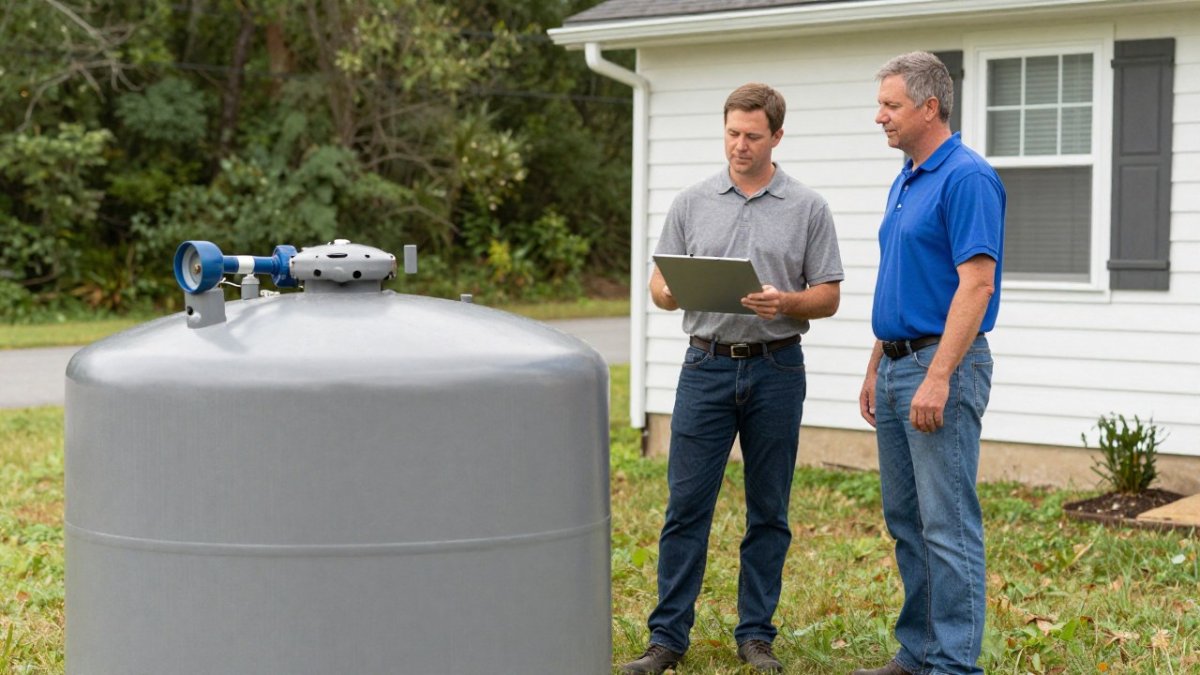
Propane technician and homeowner checking an aboveground tank for standby generator fuel in a rural backyard.
Tank sizing decides how long the generator can run before a refill. A larger tank buys more runtime but takes more space and costs more to install. The tank must also sit a safe distance from the house, windows, and property lines, and local codes set those distances. Ask the propane supplier and your electrician to confirm the setback rules before you choose a tank size.
Refill logistics matter as much as tank size. Propane suppliers typically schedule deliveries when the tank drops to a set level, so you need a supplier who can respond quickly during a regional outage, when many customers call at once. Ask how the supplier handles emergency deliveries and whether they keep a priority schedule for generator customers.
Tank size, setbacks, and refill timing shape how well propane works for your home.
Factor
What to check
Why it matters
Tank size
Larger tank
More runtime, more space needed
Tank placement
Distance from house and property lines
Set by local codes
Refills
Supplier delivery schedule
Outages draw many customers at once
Emergency delivery
Supplier priority for generator customers
Keeps the generator fueled in a regional outage
Diesel and Gasoline Options for Standby Power
Diesel and gasoline are the least common fuels for permanently installed home standby units, but they still show up at rural Moneta-area properties, farm shops, and homes that already keep fuel on site.
Diesel has the highest energy density of the four fuels, so a relatively small tank holds a lot of runtime. It stores far better than gasoline, which is why diesel dominates commercial and industrial standby power. The trade-offs for a home are real: diesel units cost more upfront, require a heated enclosure or fuel treatment in cold weather to avoid gelling, and need a fuel-polishing and filter schedule. Diesel also produces more noise and exhaust odor than a natural gas or propane unit of similar size.
Gasoline is the cheapest fuel to buy in small quantities and the easiest to source at any Moneta-area station, but it is a poor fit for standby power.
Both fuels require on-site storage that meets fire-safety rules. Aboveground tanks need secondary containment, proper venting, and clearance from the house and property lines, and the installation must follow the fuel-gas and fire codes your local building department enforces. Underground tanks add their own inspection and leak-detection requirements.
Watch out: A diesel or gasoline tank that is legal to install is not automatically legal to keep filled, confirm the tank, containment, and setback requirements with your local building office before you buy fuel, not after.
For most Moneta homeowners, diesel and gasoline offer fewer advantages than natural gas or propane unless the property already has fuel storage, sits far from both a gas main and a reliable propane supplier, or has a load profile, such as a large well pump or shop equipment, that favors diesel.
Standby Generator Runtime on Propane and Fuel Consumption
Runtime depends on two things: how much fuel the tank holds and how fast the generator burns it. Check whether a generator repair team can service the unit you plan to run on propane. Fuel consumption rises with the electrical load, so a generator powering a heat pump, a well pump, and a refrigerator will burn more propane than one carrying only the essentials. Your runtime estimate should reflect the loads you actually plan to run during an outage.
Generator manufacturers publish fuel consumption tables at several load levels, usually at 25, 50, 75, and 100 percent of rated output. Use the table that matches your expected load, not the rated maximum, to estimate how long a tank will last. Those tables are the most reliable starting point, and they should be confirmed against the specific model you install.
Estimating Fuel Consumption for Your Load
Start by listing the circuits or appliances you want powered during an outage. Add up their approximate wattage, then compare that total with the generator’s output at each load level. The manufacturer’s table will show roughly how much fuel each load level burns per hour.
Divide your usable tank capacity by the hourly consumption rate to estimate runtime. Use only part of the tank’s rated capacity in your calculation, since propane tanks are generally not filled completely. This gives a conservative figure you can plan around.
Check your math with a local electrician before you rely on it. A load that looks small on paper can grow quickly once a well pump or electric heat starts running.
Operating Cost, Permitting, and Installation in Virginia
Operating cost is where fuel choice gets real, and it is the part most national comparisons gloss over.
A workable method: pick a representative outage load, say the well pump, refrigerator, freezer, a few lights, and the blower on a propane or gas furnace, total the running watts, and match that to the manufacturer’s consumption table at the nearest load level.
Virginia permitting and code review is the other purchase-stage question broad guides skip. Standby generator installations generally require an electrical permit and inspection, and fuel-gas work may be inspected separately under the applicable fuel-gas code.
Installation scope usually includes a concrete or composite pad, the automatic transfer switch, the fuel connection, the electrical tie-in to your panel, and any gas-line or panel upgrade the load requires.
Watch out: A quote that omits the gas-line upgrade or the panel work is not a lower price, it is an incomplete scope that will surface as a change order once the permit is pulled.
For a property-specific estimate, contact Moser Electric directly; pricing depends on your fuel source, electrical capacity, and the distance from the meter or tank to the generator pad. See the full range of whole-home generator services offered in your region.
Choosing a Fuel Source and Scheduling Your Installation Assessment
Choosing a fuel source comes down to four checks: does the property have natural gas, how much outage coverage do you need, how much space is available for a propane tank, and how much maintenance you are willing to handle. Natural gas wins on convenience when it is available. Propane fills the gap when it is not, provided you size the tank and arrange reliable refills.
A professional assessment is the fastest way to answer those questions for your property. Find a Lynchburg electrician who installs generators and can book your assessment. A licensed electrician can check your gas line, panel capacity, and tank placement options. If your panel needs work to support a standby generator, a panel upgrade can be planned alongside the installation. Learn more about panel upgrades for homes adding standby power.
There is no single best fuel. Natural gas is the most convenient when your property already has a utility gas line, because supply is continuous and there is no tank to refill. Propane suits properties without gas service, since an on-site tank can be sized to hold several days of runtime. Diesel offers long runtimes and durability but needs fuel storage and regular maintenance. The right choice depends on fuel availability at your property, how long you need to run during outages, and the operating cost of each fuel locally. A licensed installer can run the numbers for your load and your site.
How long will a 100-gallon propane tank run a whole-house generator?
Runtime depends on the generator’s size, the electrical load you run during an outage, and the tank’s usable capacity. Propane tanks are typically filled to about 80 percent of capacity for safety, so a 100-gallon tank provides roughly 80 gallons of usable fuel. A generator drawing a moderate load may run for many hours on that fuel, while heavy loads such as central air conditioning and well pumps will shorten runtime considerably. Ask your installer for a runtime estimate based on your specific generator model and the loads you plan to power.
Is natural gas or propane better for a standby generator?
Natural gas is better when pipeline service is already available at the property, since it needs no tank and no refill planning. Propane is the better option where there is no gas line, and a delivered tank gives you a stored fuel supply that does not depend on the utility network. Propane generally costs more per unit of energy than natural gas, and it requires a tank, delivery scheduling, and periodic refills. Compare current local rates and delivery costs, and confirm the generator is rated for the fuel you choose.
How do I choose a generator fuel source if natural gas is not available?
Start with propane or diesel. Propane is the most common choice for homes without natural gas because it is clean-burning and can be stored in an on-site tank filled by a delivery company. Diesel can offer longer runtime per gallon, but it requires a larger storage tank and ongoing maintenance of the fuel itself. Consider how often you can arrange refills, how much storage space you have, and how long your typical outages last. A site visit from a qualified electrician can help you size the tank and confirm the installation meets local code requirements.
We use cookies to ensure that we give you the best experience on our website. If you continue to use this site we will assume that you are happy with it.